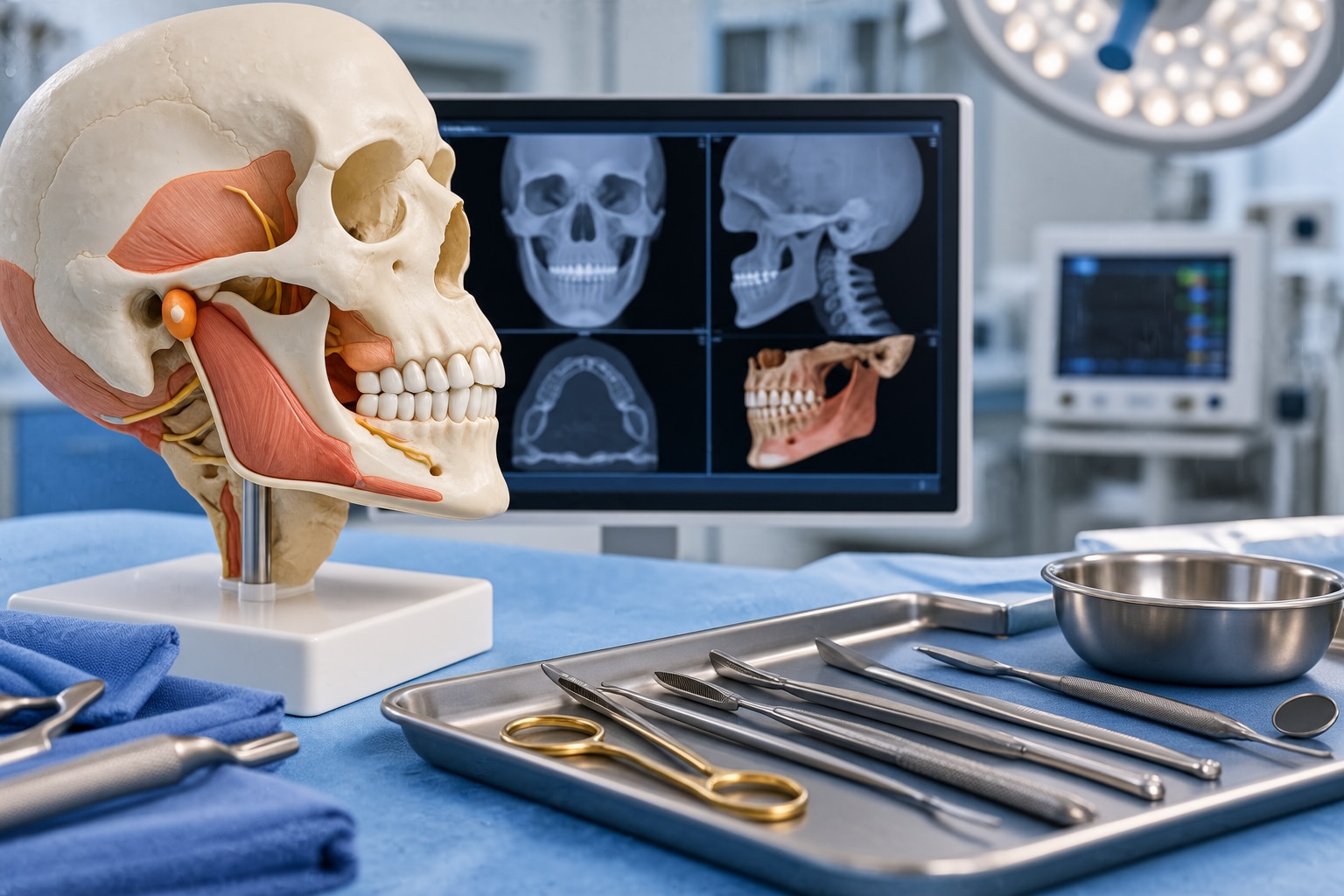
A maxillofacial referral can involve far more than routine tooth removal: it may address facial trauma, deep infection, jaw growth, bite problems, salivary-gland disease or a suspicious lesion. You will be able to identify the procedures involved, recognise urgent warning signs, prepare for assessment and compare the support available for treatment near Palava.
Key takeaways
- Facial swelling with breathing or swallowing trouble needs emergency assessment.
- Maxillofacial teams treat jaw fractures, infections, cysts, tumours and bite problems.
- Ask which scans, specialists and hospital facilities your proposed treatment requires.
- Jaw surgery planning can include orthodontics, imaging, blood tests and recovery support.
Which conditions and procedures can a maxillofacial team handle?
A search for maxillofacial surgery Palava may lead to care for problems involving the mouth, jaws, face, neck and related soft tissues—not just routine dental pain. Common reasons include impacted wisdom teeth, jaw fractures, facial infections, cysts or tumours, salivary-gland disease, congenital facial conditions, bite-related jaw discrepancies and temporomandibular-joint disorders.
| Condition | Procedure that may be offered | Main purpose |
|---|---|---|
| Impacted wisdom tooth | Surgical removal, sometimes with sedation or general anaesthesia | Prevent or treat recurrent infection, decay, cysts or damage to nearby teeth |
| Facial or jaw fracture | Reduction and fixation with plates and screws | Restore bone position, bite, facial shape and function |
| Abscess or deep infection | Incision, drainage, antibiotics and removal of the dental source | Release trapped pus and control infection |
| Cyst, tumour or unexplained lesion | Biopsy, followed by removal or referral for specialist treatment | Establish a tissue diagnosis and treat the cause |
| Jaw-growth or bite discrepancy | Orthognathic surgery with orthodontic treatment before and after | Improve chewing, speech, swallowing, breathing or facial balance |
| Temporomandibular-joint disorder | Splints, injections, arthroscopy or open joint surgery when indicated | Reduce pain or restore restricted joint movement |
Facial reconstruction can repair bone and soft tissue after trauma, infection or tumour removal, and address congenital differences. Treatment may also involve salivary-gland surgery or corrective procedures for children with cleft-related and other growth problems.
An impacted wisdom tooth does not automatically need removal if it causes no disease. The decision weighs its position, nerve proximity, future risk and the possible complications of surgery, including pain, infection and nerve disturbance.
When does a facial or jaw problem need urgent assessment?
A facial or jaw problem needs urgent assessment when swelling, injury or a new growth threatens breathing, vision, swallowing, bleeding control or normal jaw movement. Facial swelling with fever, especially when it spreads into the neck or floor of the mouth, needs emergency review rather than a routine appointment.
- Call emergency services for breathing difficulty, inability to swallow saliva, or major bleeding. Sit upright, keep the airway clear and apply firm pressure to an accessible bleeding site with clean gauze.
- If a permanent tooth has been knocked out, hold it by the crown, not the root. Place it in milk or tooth-preservation solution without scrubbing the root, then seek immediate dental or emergency care.
- Do not force a suspected jaw fracture back into position. Support the jaw gently, avoid food and drink if surgery may be needed, and obtain urgent assessment.
Go to an emergency department after facial trauma if your jaw is displaced, your bite has suddenly changed, you cannot open your mouth normally, or numbness affects the lip, chin or cheek. Double vision, reduced vision and rapidly increasing facial swelling are also warning signs.
A stable, longstanding dental or jaw complaint without these signs can follow a routine referral. A rapidly growing facial or neck lesion needs prompt specialist assessment even without pain.
A search for facial surgery Palava should lead you to ask whether a maxillofacial surgeon Palava service can assess airway risk, infection, fractures and suspicious tissue rather than treating the issue as routine dental care.
Which specialist should you see, and how will the problem be investigated?
The right referral depends on whether the problem is dental, skeletal, airway-related, traumatic or cosmetic—not simply where it hurts. A search for a maxillofacial surgeon Palava should lead you to the specialist whose work matches the problem.
| Specialist | Problems typically led |
|---|---|
| Dentist | Tooth decay, gum disease, routine dental pain and prevention |
| Oral surgeon | Difficult tooth removal, impacted wisdom teeth and minor oral surgery |
| Orthodontist | Tooth alignment and bite correction with braces or aligners |
| Maxillofacial surgeon | Jaw fractures, facial infections, cysts, tumours, jaw deformity, joint disease and complex reconstruction |
| ENT specialist | Nose, sinus, throat, ear and airway disorders |
| Plastic surgeon | Soft-tissue reconstruction, scarring and appearance-focused facial surgery |
| Neurosurgeon | Brain, skull-base and major nerve conditions |
Assessment starts with your symptom or injury history and an examination of your teeth, bite, jaw movement, face, neck and nerves. The team may take dental and facial photographs, panoramic X-rays for the jaws and teeth, and cephalometric X-rays for jaw relationships.
CT or cone-beam CT shows bone and fracture detail; MRI assesses soft tissue or the temporomandibular joint. A biopsy is needed when a lump, ulcer or other lesion requires tissue diagnosis.
Bring these items to the consultation:
- Previous scans, dental records and reports
- Medication and allergy lists, including anticoagulant details
- Pregnancy information and a clear symptom or injury timeline
Fast only when the surgical team gives instructions for sedation or anaesthesia. Do not fast for a routine consultation unless told to do so.
What does jaw surgery involve before, during and after the operation?
Orthognathic surgery is assessed for people with a significant upper-jaw discrepancy, lower-jaw discrepancy or combined skeletal discrepancy that braces alone cannot correct. If the problem is tooth alignment alone, orthodontic treatment—not jaw surgery—is the appropriate route.
A search for jaw surgery Palava should therefore lead to an assessment of bone position, facial balance and bite, not just the appearance of individual teeth.
1. Before surgery, the team records your bite, takes dental and facial photographs, and reviews X-rays. Cone-beam CT or other 3-D imaging can show jaw structures and support virtual surgical planning, but the surgeon still needs a clinical examination.
Orthodontic treatment usually starts before the operation to position the teeth correctly for the planned jaw movement.
2. During surgery, the upper jaw, lower jaw or both are repositioned according to the plan. Plates and screws hold the bones in their new positions while they heal. The operation takes place under anaesthesia, with the exact approach depending on the jaws involved and the required movement.
3. After surgery, expect reviews for bite position, swelling, wound healing, altered sensation and mouth opening. Your team will explain oral-hygiene measures and move your diet from liquids to soft foods before normal textures as healing permits.
4. Orthodontic treatment usually continues after surgery. Follow-up appointments check the bite and healing, adjust braces and identify problems such as persistent numbness, infection, difficulty opening the mouth or a bite that does not settle as planned.
How should you compare maxillofacial care near Palava?
Compare capacity, not clinic labels, when choosing facial surgery Palava. Ask whether the service can handle the anaesthesia, imaging, airway and monitoring needs of your procedure, rather than assuming a dental setting provides hospital-level backup.
| Option | What to compare | Question to ask |
|---|---|---|
| Dental-only clinic | Local anaesthesia, selected intravenous sedation, routine imaging and day-care treatment | Can you provide CT or cone-beam CT, and what happens if airway support or overnight observation is needed? |
| Hospital-based service | Local anaesthesia, intravenous sedation or general anaesthesia, an operating theatre and emergency airway management | Which anaesthetist and theatre facilities are available for this procedure? |
| Dental-only clinic | Limited support for complex infection, trauma or tumour care | Can you coordinate pathology, blood tests or transfusion, and oncology review when indicated? |
| Hospital-based service | Paediatric care, inpatient monitoring and multidisciplinary coordination | Is overnight monitoring available, and who arranges planned follow-up? |
Facial surgery is not only about appearance. After trauma, infection, tumour removal or congenital deformity, treatment can restore chewing, speech, swallowing, breathing, eye protection and facial symmetry.
For children, ask whether the team understands facial growth and can coordinate care when treatment must be timed around development. For maxillofacial surgery Palava, Aurindam Hospital gives patients a local option to ask about these facilities, specialist coordination and inpatient or outpatient support before choosing care.
Share anticoagulant or antiresorptive medicines, allergies and previous anaesthesia problems before scheduling surgery.
Related service
Cosmetic and Plastic Surgery Cosmetic Plastic & Reconstructive Surgery Plastic, Cosmetic & Reconstructive Surgery" refers to three interrelated but distinct fields within surgical practice focused on restoring,... View service → |
Frequently asked questions
Which conditions can a maxillofacial team treat?
A maxillofacial team can assess impacted wisdom teeth, jaw fractures, facial infections, cysts, tumours, salivary-gland disease, congenital facial conditions, bite-related jaw discrepancies and temporomandibular-joint disorders.
When does a facial or jaw problem need urgent assessment?
Seek urgent assessment for facial swelling with breathing or swallowing difficulty, uncontrolled bleeding, a serious facial injury, rapidly spreading infection, severe pain with fever, or new weakness or loss of vision.
Which specialist should I see for a jaw or facial problem?
A maxillofacial surgeon assesses problems involving the mouth, jaws, face, neck and related soft tissues. Your dentist, doctor or emergency clinician can help direct you to the right service.
How is a jaw problem investigated before surgery?
Assessment can include a medical and dental history, examination of your bite and jaw movement, dental X-rays, panoramic imaging, CT or MRI scans, photographs, blood tests and dental or orthodontic records.
What does jaw surgery involve before, during and after the operation?
Preparation can include scans, orthodontic treatment, medical checks and consent. During surgery, the surgeon repositions or repairs the jaw under anaesthesia, often using plates and screws. Recovery includes pain control, a modified diet, oral hygiene, follow-up visits and bite monitoring.
Keywords