Newborn care can begin in the delivery room and continue through monitoring, feeding support, treatment, discharge planning and follow-up. By understanding each stage and the differences between nursery, special-care and intensive-care services, you can ask more precise questions when choosing neonatal care near Kalyan.
Key takeaways
- Ask for a neonatologist’s assessment if your baby has breathing, feeding, temperature, or oxygen problems.
- Expect delivery-room checks of breathing, heart rate, colour, temperature, weight, and blood glucose.
- Compare staffing, respiratory support, infection control, visiting rules, and parent communication before admission.
- Before discharge, confirm feeding, medicines, follow-up appointments, warning signs, and emergency contact numbers.
When a newborn needs a neonatologist
Routine postnatal care suits a baby who breathes normally, maintains temperature, feeds effectively, has reassuring colour and examination findings. A neonatologist should assess any newborn born before 37 weeks, weighing under 2.5 kg, or showing breathing difficulty, poor feeding, low temperature, abnormal oxygen levels, suspected infection, seizures, birth injury or jaundice requiring treatment.
| Care level | Newborn signs | Why specialist assessment matters |
|---|---|---|
| Routine care | Stable breathing, temperature, colour and feeding | The baby can usually remain with the mother while staff perform scheduled checks. |
| Neonatal assessment | Prematurity, low birth weight, glucose concerns, feeding difficulty or abnormal examination | The baby may need continuous monitoring, blood tests, incubator or warmer care, and treatment. |
| Urgent neonatal care | Respiratory distress, blue or grey colour, seizures, severe lethargy or repeated vomiting | Delay can worsen oxygen shortage, infection, low blood sugar or another serious condition. |
Seek immediate assessment rather than waiting for a routine appointment if your baby has:
- Fast, laboured or stopped breathing, grunting, chest indrawing or persistent blue colour
- Temperature below 36.5°C or above 37.5°C
- Jaundice during the first 24 hours, worsening yellow colour or unusual sleepiness
- Inability to feed, repeated vomiting, very few wet nappies or marked weakness
A neonatologist in Kalyan can coordinate care with paediatricians and other specialists. When comparing newborn care in Kalyan, confirm that the unit can provide 24-hour neonatal coverage and arrange rapid transfer if the baby needs support beyond its capability.
What happens from delivery-room assessment to diagnosis
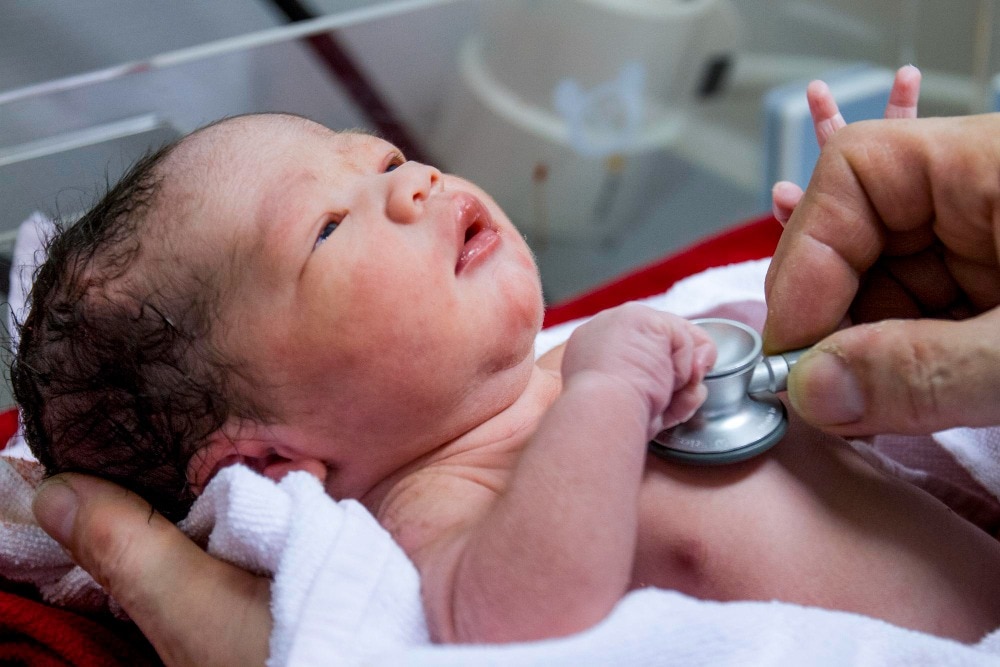
At birth, the neonatologist starts with a physical examination and vital-sign monitoring. The team checks whether the baby is breathing effectively, maintaining colour and oxygen levels, staying warm, circulating blood well, feeding safely and showing signs of infection, birth injury or neurological difficulty. Blood glucose is measured when risk factors or symptoms make it necessary.
The decision usually falls into one of four levels:
- Routine care: The baby establishes breathing, has stable observations, feeds effectively and needs only warmth, examination and standard newborn monitoring.
- Observation: The baby has a borderline temperature, mild breathing effort, feeding difficulty, low glucose or jaundice that needs repeat checks, measurements or short-term support.
- Admission: Persistent respiratory distress, oxygen need, apnea, suspected infection, seizures, significant low glucose, poor feeding or prematurity requires continuous monitoring and treatment in a special-care nursery or NICU.
- Transfer: The baby needs support beyond the unit’s capability, such as mechanical ventilation, surgery or specialist intensive care. The team stabilises the baby and arranges monitored emergency transport.
Diagnosis combines examination with targeted tests rather than appearance alone. For jaundice, clinicians use the bilirubin result, the baby’s age in hours, gestational age and risk factors to choose observation, phototherapy or escalation.
They may order blood tests, cultures, glucose checks, chest imaging or brain monitoring when symptoms point to infection, respiratory disease, metabolic problems or seizures. Families comparing neonatal care Kalyan services should ask how quickly diagnosis, specialist review and transfer can occur.
What care a newborn may receive in a NICU
A NICU stay can include warming, monitoring, breathing support, medicines, tests and a carefully planned feeding programme. An incubator or radiant warmer controls temperature, while ECG leads, oxygen-saturation probes, blood-pressure cuffs and glucose checks show how the baby is responding. If breathing remains ineffective, support can progress from supplemental oxygen to CPAP or mechanical ventilation.
Treatment may include:
- Intravenous fluids or nutrition when feeding is unsafe or insufficient.
- Antibiotics when infection is suspected, after clinicians collect appropriate cultures.
- Phototherapy for significant jaundice.
- Caffeine and monitoring for repeated apnea in premature babies.
- Blood products or specialist procedures when the baby’s condition requires them.
Feeding support does not automatically mean stopping breastfeeding. Staff can observe a breastfeed, improve positioning and attachment, provide expressed breast milk, and use a cup or feeding tube when sucking is weak or unsafe. They track weight, urine, stool, glucose and hydration.
| Care level | Equipment and treatment | When it applies |
|---|---|---|
| Basic newborn care | Warming, examination and routine observation | A stable baby needing temperature or feeding support |
| Special-care nursery | Continuous monitoring, oxygen or CPAP, intravenous treatment and tube feeds | A baby needing more support without invasive ventilation |
| NICU | Mechanical ventilation, advanced monitoring and multidisciplinary treatment | Severe breathing failure, extreme prematurity or complex illness |
If you searched “neonatology hospital kalyan” or “neonatal care kalyan”, ask about 24-hour neonatal cover, specialist backup and emergency transfer when needs exceed the unit’s capability.
What parents can expect inside a newborn-care unit
Expect incubators or radiant warmers, cardiorespiratory monitors, oxygen tubing, feeding tubes and staff checking your baby at set intervals. Beeping does not always signal an emergency; ask which alarm belongs to your baby and what response it requires.
During newborn care in Kalyan, staff will explain your baby’s breathing, temperature, glucose, feeding, urine, stool, weight and test results. You should receive updates from the nurse and neonatologist, including changes in treatment, progress toward discharge and warning signs to report.
Parents are usually asked to:
- Clean their hands before touching the baby and follow visitor and infection-control rules.
- Provide expressed breast milk in labelled containers, if direct breastfeeding is not yet safe or effective.
- Join a breastfeed assessment so staff can check positioning, attachment and swallowing.
- Hold the baby skin-to-skin when the clinical team confirms it is safe.
- Tell staff about changes in colour, breathing, alertness, vomiting, temperature or feeding.
- Ask before bringing clothing, formula, medicines or personal equipment into the unit.
- Learn how to give prescribed medicines, use feeding equipment and attend follow-up appointments before discharge.
Ask whether parents can visit at any hour, who provides 24-hour medical cover, and how emergency transfer works if the unit cannot provide the needed respiratory or surgical support.
How to compare neonatal care and prepare for discharge
Choose a unit by the care it can deliver, not by the word “NICU” on its sign. A neonatology hospital near Kalyan should explain its limits, its referral pathway and who is medically available overnight.
| Care level | Capability to verify | Transfer question |
|---|---|---|
| Basic newborn care | Examination, feeding support, glucose checks and jaundice assessment | Where does a baby needing respiratory support go? |
| Special-care nursery | Continuous monitoring, oxygen or non-invasive support, tube feeding and phototherapy | Which conditions require transfer? |
| Intensive neonatal care | Mechanical ventilation, intravenous treatment, blood-bank access and specialist backup | Who arranges transport, and how quickly? |
Ask these questions before admission:
- Is a neonatologist in Kalyan available 24 hours, or only on call?
- Can parents provide skin-to-skin care, and how is expressed breast milk labelled, stored and given?
- Which monitoring and breathing support are available on-site?
- Are pediatric surgery, imaging, laboratory, blood-bank, ophthalmology and anesthesia services accessible?
- If the baby worsens, which hospital receives the transfer and who travels with the baby?
Aurindam Hospital should be assessed with the same questions: capability matters more than a service-list label.
Before discharge, get written instructions covering feeding volumes or breastfeeding targets, weight review, temperature control, medicines, jaundice warning signs, safe sleep, immunizations and the next appointment. Take the baby urgently for breathing difficulty, blue colour, seizures, repeated vomiting, poor feeding, unusual sleepiness, fever or low temperature.
Babies leaving intensive care may also need scheduled checks for growth, hearing, vision, anaemia, lung disease, development and feeding.
Related services
Neonatology Neonatology Neonatology is a subspecialty of pediatrics that focuses on the medical care of newborn infants, especially the ill or premature. |
Neonatology and Pediatrics Neonatology & Neonate Intensivist Neonatology: Neonatology is a specialized branch of Pediatrics that focuses on the medical care of newborn babies, especially: Premature babies (born... View service → |
Frequently asked questions
When does a newborn need a neonatologist?
A neonatologist should assess babies born before 37 weeks, weighing under 2.5 kg, or showing breathing difficulty, poor feeding, low temperature, abnormal oxygen levels, suspected infection, seizures, birth injury, or jaundice requiring treatment.
What happens after a newborn is assessed in the delivery room?
The team checks breathing, heart rate, colour, temperature, weight, oxygen levels, feeding ability, and examination findings. They may order blood tests, glucose testing, bilirubin measurement, cultures, or imaging when symptoms require investigation.
What care can a newborn receive in a NICU?
NICU care can include continuous monitoring, oxygen or non-invasive breathing support, intravenous fluids, tube feeding, antibiotics, treatment for low blood glucose, phototherapy for jaundice, and support for temperature control.
What should parents expect inside a newborn-care unit?
Parents can expect monitoring equipment, hand hygiene and infection-control procedures, restricted visiting during clinical care, updates from the medical team, feeding guidance, and instructions for expressing breast milk when direct breastfeeding is not possible.
How should parents compare neonatal care units and prepare for discharge?
Compare neonatologist availability, nursing coverage, respiratory support, laboratory and imaging access, infection-control practices, visiting policies, and emergency transfer arrangements. Before discharge, confirm feeding, medicines, follow-up, warning signs, and contact numbers.
Keywords